Find the motion
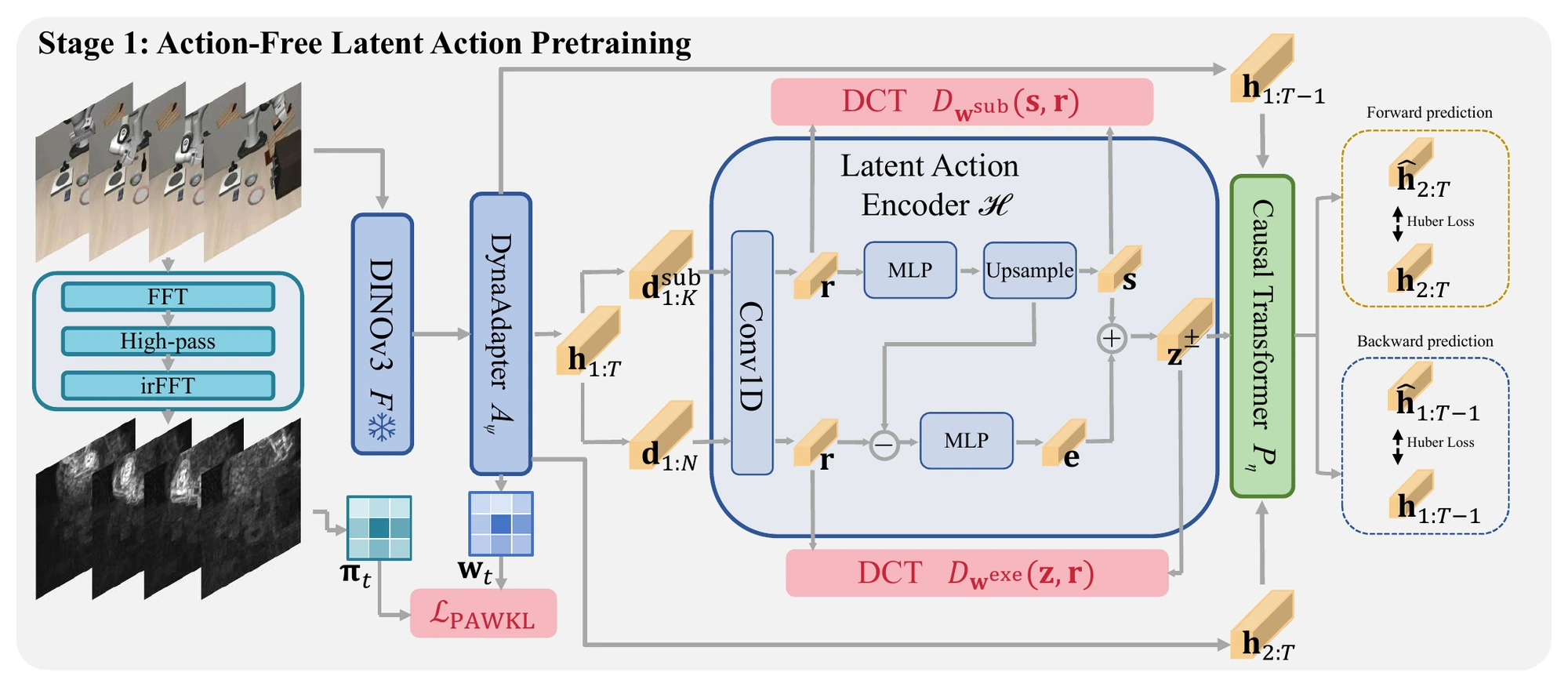
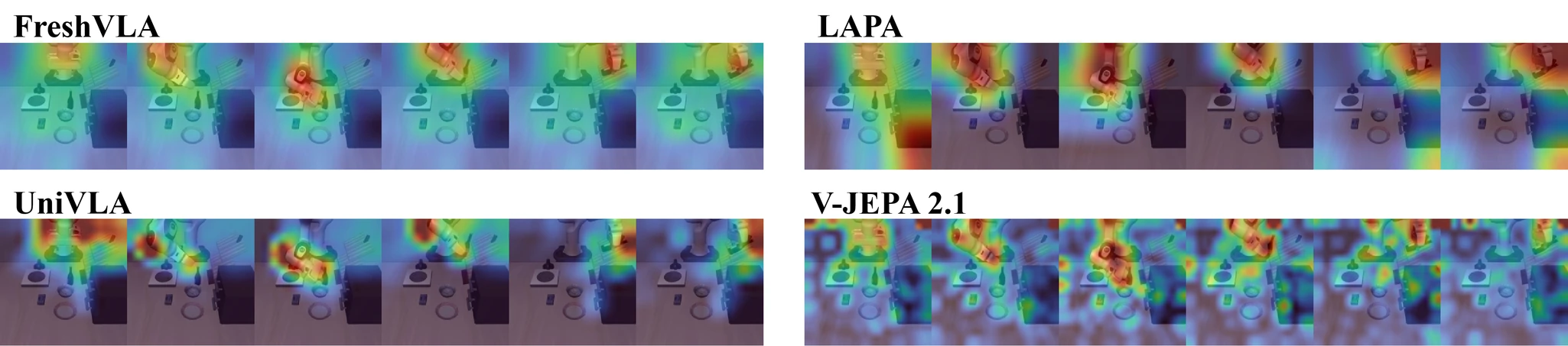
DynaAdapter learns which visual patches change as the gripper approaches and moves an object.
High-pass visual prior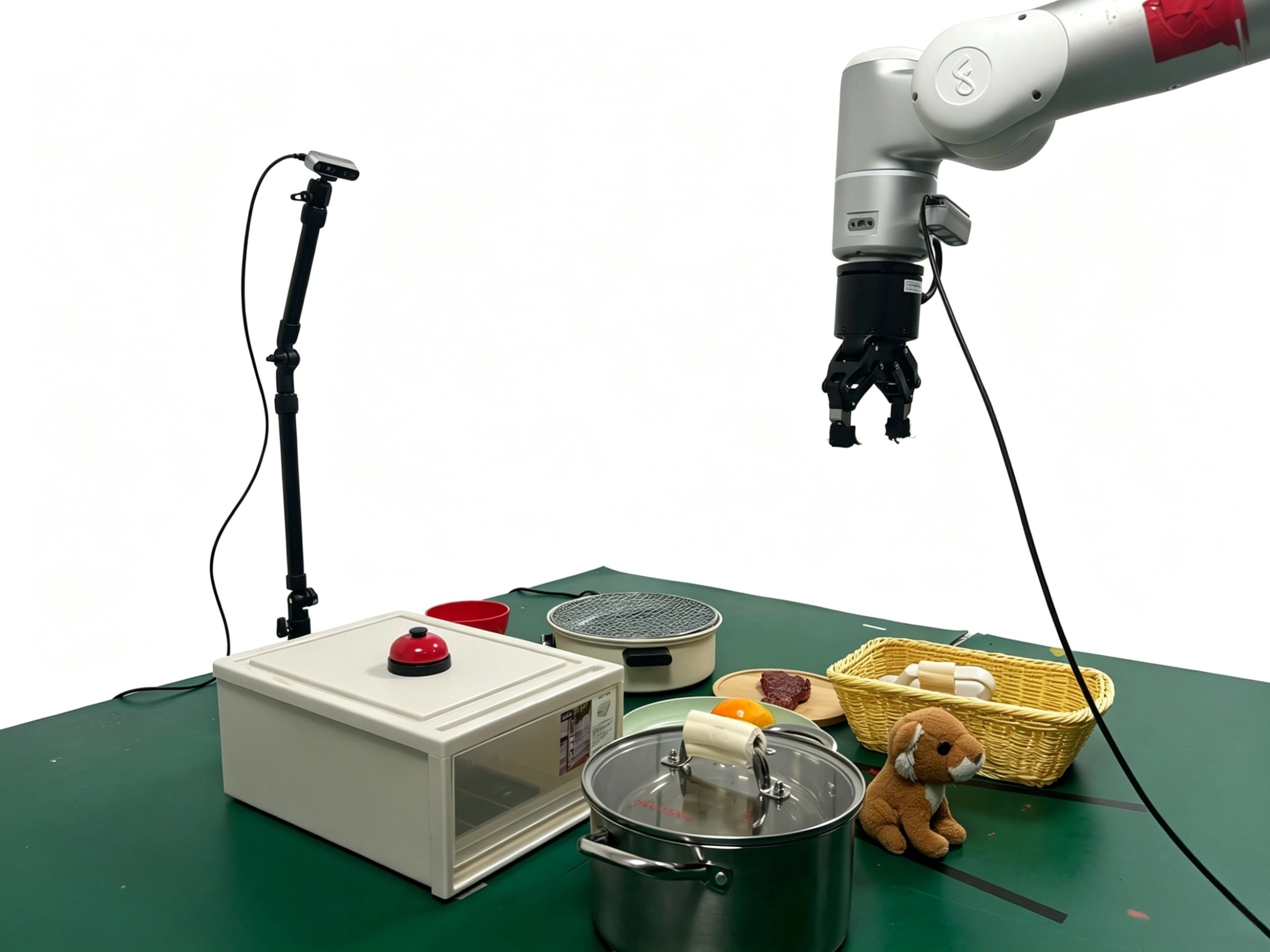
Research preprint
Frequency-Regularized Time Scale Hierarchical Latent Actions for Vision-Language-Action Models
* Equal contribution† Project lead‡ Corresponding author
The central idea
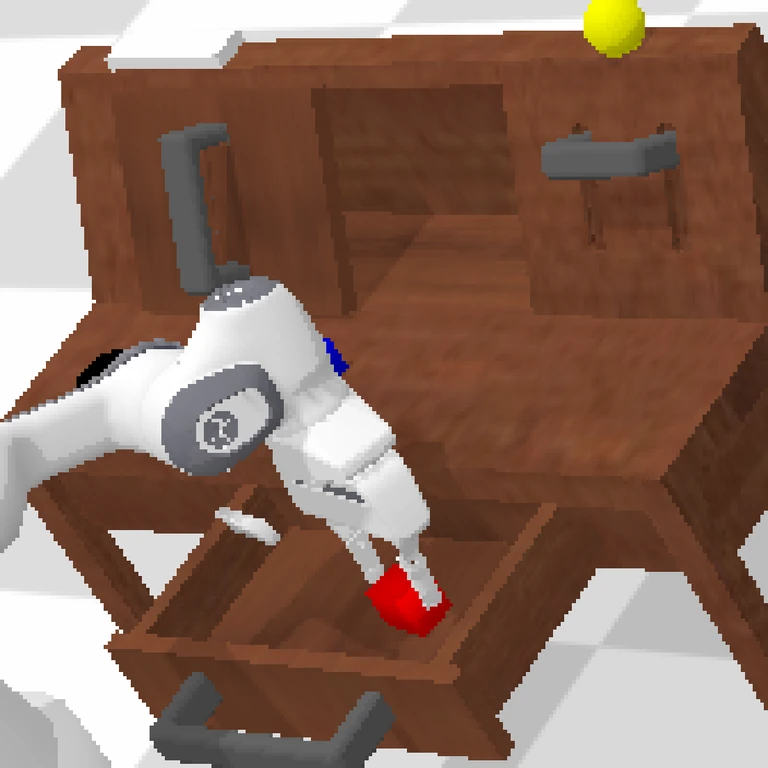
Watch a robot open a pot. Over several frames, the lid lifts clear. From one frame to the next, the gripper makes small adjustments at the handle.
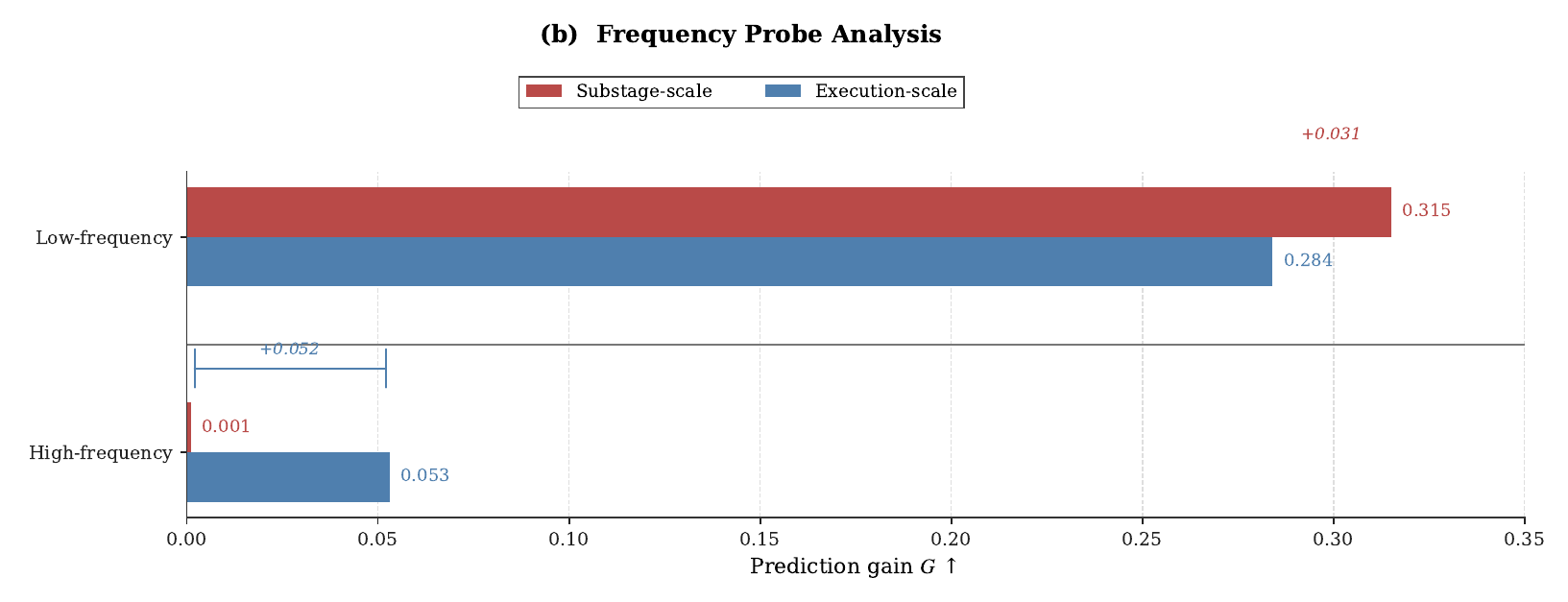
Predictive R² on held-out robot motion
Abstract
A video can show how an object moves without recording the command that moved it. FreshVLA learns to represent those visual changes, then uses robot demonstrations to connect them to control.
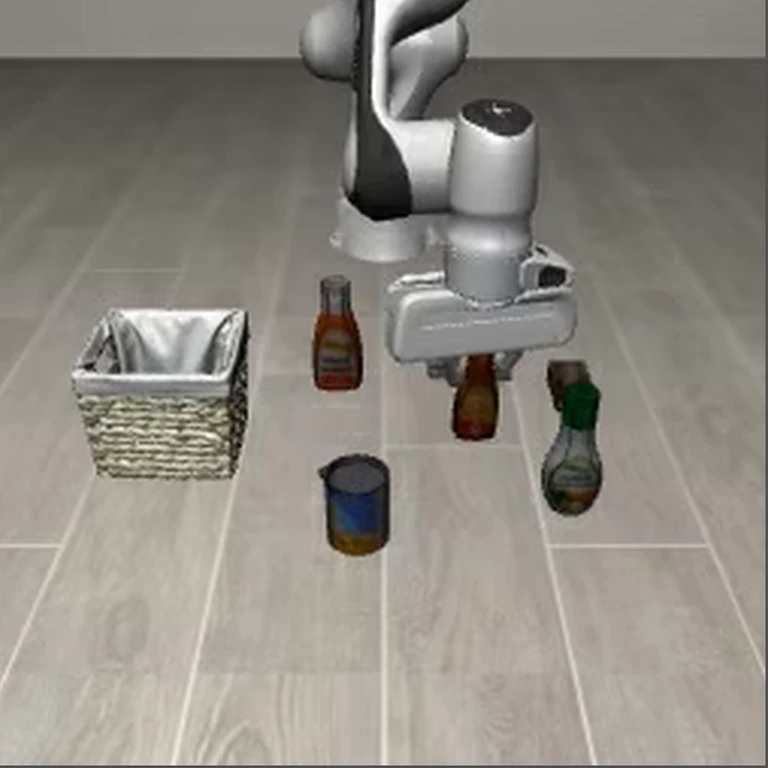
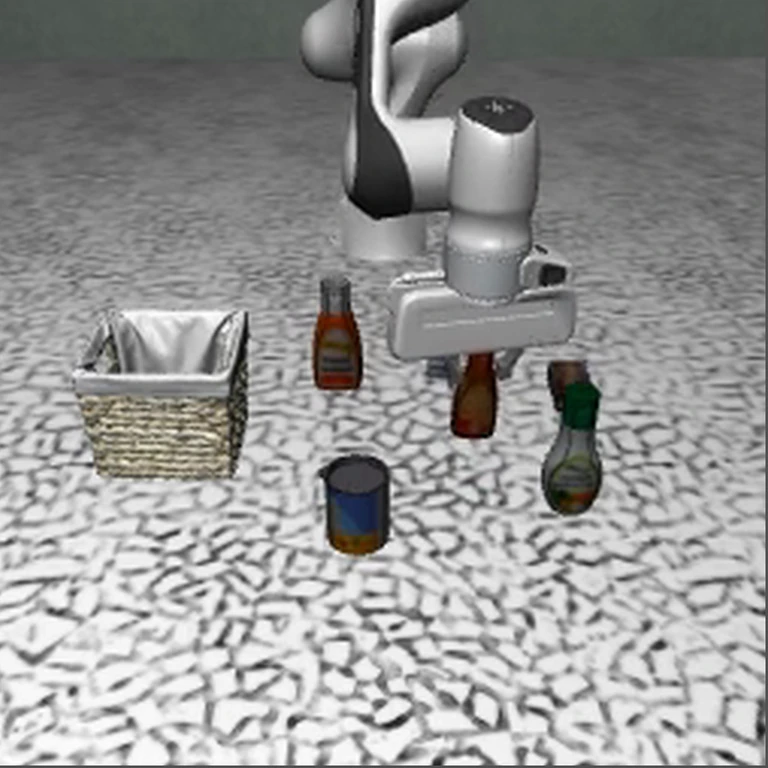
A static tabletop makes much of the next frame predictable, even if a model misses a small gripper movement. FreshVLA uses a temporal high-pass prior to guide DynaAdapter’s attention toward image patches that change.
 Enlarge figure
Carrying an object across the workspace takes many frames. A small adjustment of the grasp can happen between two. The substage stream captures slower task progress, guided by a low-frequency objective. The execution stream encodes the motion left at each step.
| Structure | Discrete | Continuous |
|---|---|---|
| Single-layer | 95.0%Long 92.0% | 96.0%Long 93.0% |
| Hierarchical | 88.1%Long 72.3% | 98.2%Long 98.0% |
With continuous latents, the two-scale design improves LIBERO-Long success by 5.0 percentage points over a single layer.
Joint flow matchingFreezing the encoder keeps the video-derived targets stable while the policy learns to generate latent actions and robot commands together.
Method
FreshVLA first learns how a scene changes, then uses those representations to train a language-conditioned policy.
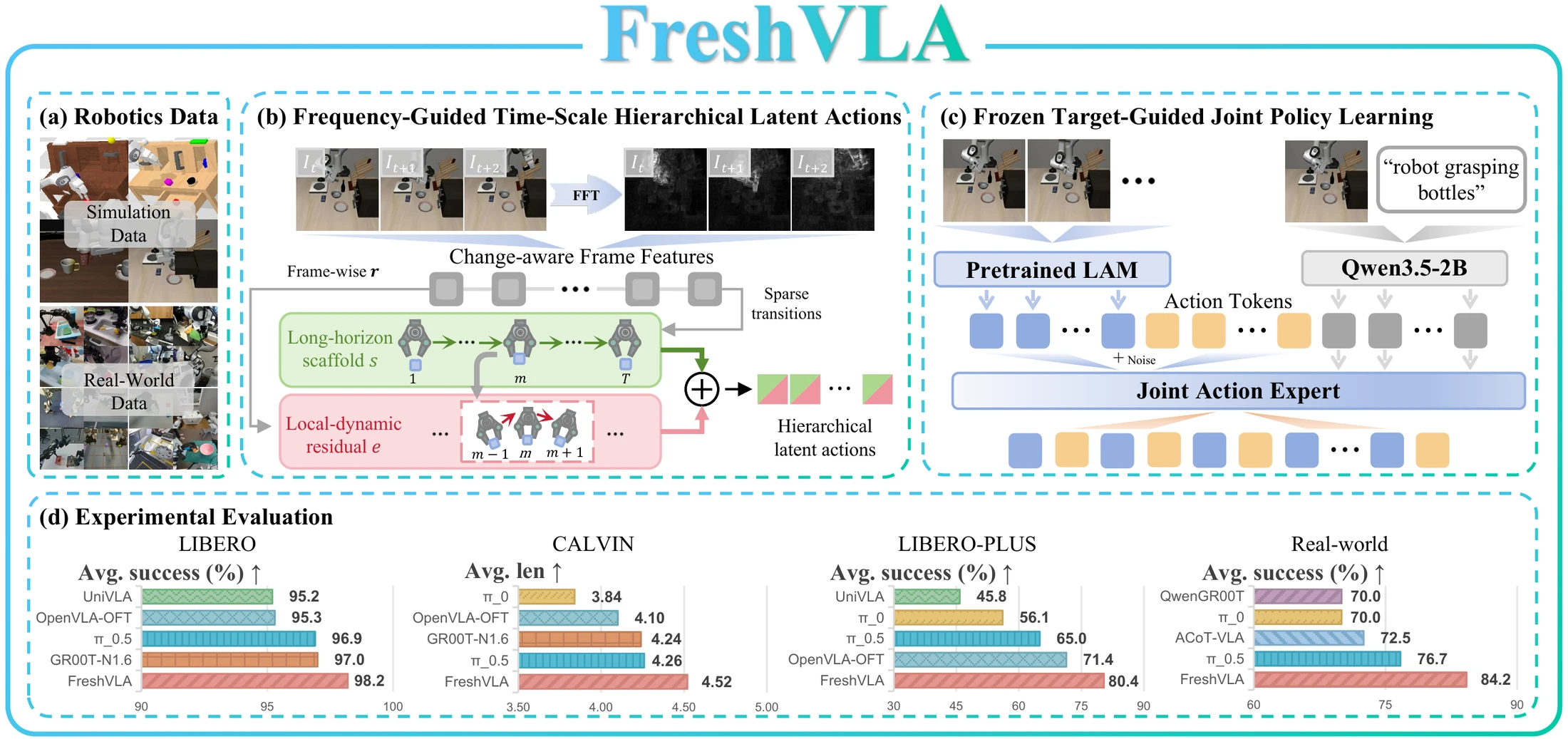
DynaAdapter learns which visual patches change as the gripper approaches and moves an object.
High-pass visual priorA substage latent tracks slower progress. An execution latent describes the local residual motion.
Frequency regularizationA frozen encoder supplies targets while a flow-matching policy jointly denoises latent actions and robot actions.
Joint flow matchingLIBERO average success
Zero-shot LIBERO-PLUS
CALVIN mean sequence length
Real-robot average success
Results
Select a simulation scene to explore the results.
| Method | Spatial | Object | Goal | Long | LIBERO avg. |
|---|---|---|---|---|---|
| OpenVLA-OFT | 96.2 | 98.3 | 96.2 | 90.7 | 95.3 |
| π0.5 | 98.8 | 98.2 | 98.0 | 92.4 | 96.9 |
| GR00T-N1.6 | 97.7 | 98.5 | 97.5 | 94.4 | 97.0 |
| FreshVLA | 98.7 | 99.7 | 96.3 | 98.0 | 98.2 |
On LIBERO-Long, FreshVLA reaches 98.0% success, 3.6 percentage points above GR00T-N1.6.
| Method | Camera | Robot | Language | Light | Background | Noise | Layout | Avg. |
|---|---|---|---|---|---|---|---|---|
| OpenVLA-OFT | 56.4 | 31.9 | 79.5 | 88.7 | 93.3 | 75.8 | 74.2 | 71.4 |
| π0.5 | 53.0 | 50.3 | 65.7 | 83.1 | 77.3 | 53.2 | 72.7 | 65.0 |
| FreshVLA | 60.0 | 58.9 | 88.9 | 97.0 | 97.1 | 84.4 | 76.3 | 80.4 |
| Method | 1 task | 2 tasks | 3 tasks | 4 tasks | 5 tasks | Mean length |
|---|---|---|---|---|---|---|
| OpenVLA-OFT | 96.3 | 89.1 | 82.4 | 75.8 | 66.5 | 4.10 |
| π0.5 | 94.4 | 88.4 | 85.3 | 80.1 | 76.1 | 4.26 |
| GR00T-N1.6 | 96.3 | 91.4 | 85.3 | 79.7 | 71.7 | 4.24 |
| FreshVLA | 99.6 | 97.9 | 92.4 | 85.1 | 77.5 | 4.52 |
| Method | Open Pot | Warmup Dinner | Organize Bowls | Collect Toys | Avg. |
|---|---|---|---|---|---|
| π0 | 96.7 | 63.3 | 53.3 | 66.7 | 70.0 |
| QwenGR00T | 93.3 | 60.0 | 66.7 | 60.0 | 70.0 |
| ACoT-VLA | 96.7 | 70.0 | 56.7 | 66.7 | 72.5 |
| π0.5 | 96.7 | 66.7 | 80.0 | 63.3 | 76.7 |
| FreshVLA | 96.7 | 80.0 | 86.7 | 73.3 | 84.2 |
Real robot
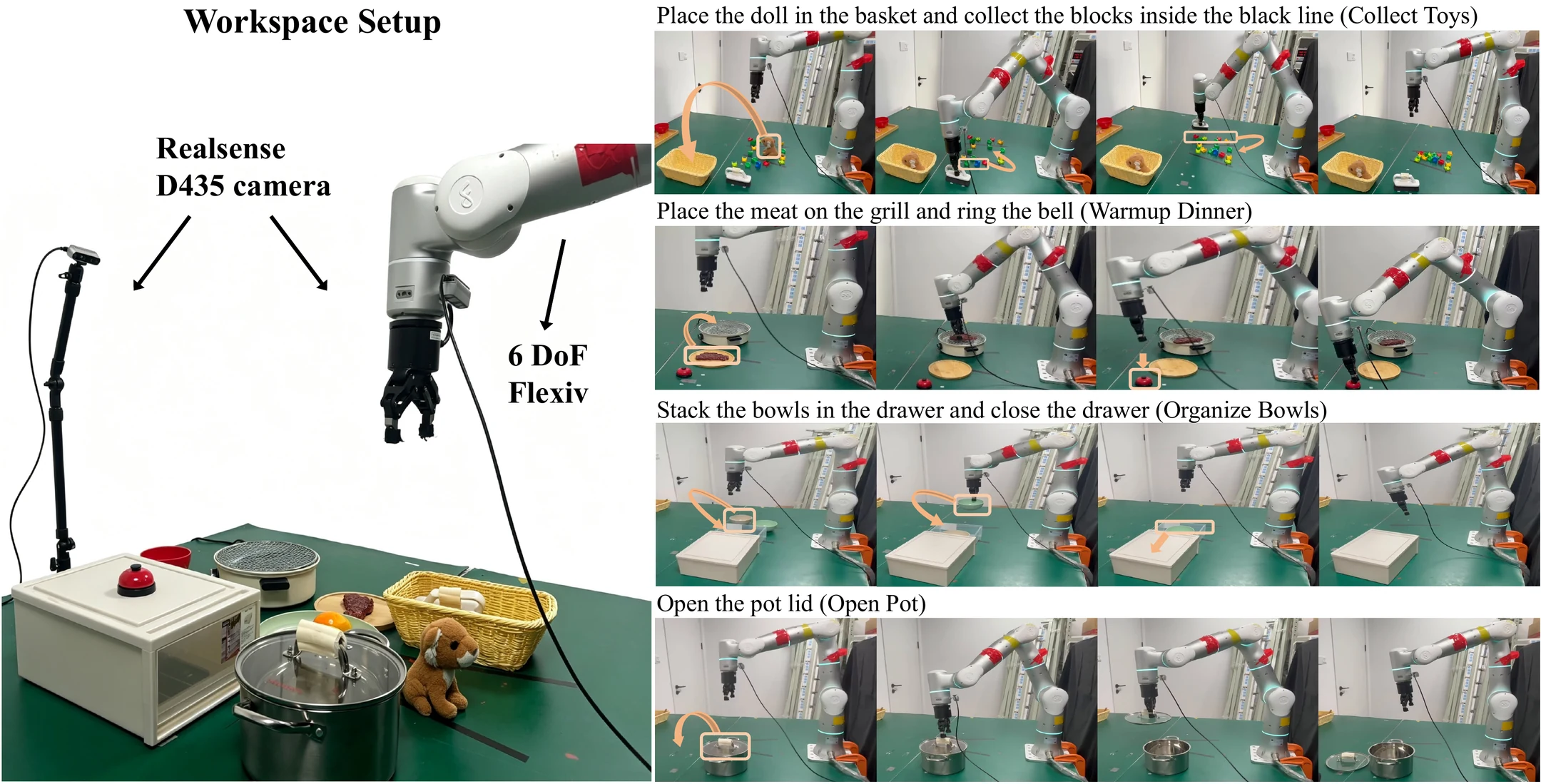
Four language-conditioned tasks on a 6-DoF Flexiv arm.
86.7%Task success

96.7%Task success

80.0%Task success

73.3%Task success

Resources
Read the manuscript, benchmark protocols, and supplementary analyses.
Read PDFInspect DynaAdapter, the two latent streams, and their training objectives.
View figureSee the Flexiv arm, camera placement, and image sequences from all four tasks.
View setupCitation
@misc{liang2026freshvla,
  title  = {{FreshVLA}: Frequency-Regularized Time Scale Hierarchical
            Latent Actions for Vision-Language-Action Models},
  author = {Liang, Jiaming and Zhan, Yifeng and He, Rongyi and
            Li, Mu and Fan, Jiaqi and Zhang, Zhiyuan and
            Liang, Qiwei and Zhang, Zhengjie and Cai, Boyang and
            Zhang, Ningyuan and Jing, Xingjian and Nie, Qiang},
  year   = {2026},
  note   = {Preprint}
}